
From Smart Newsrooms to the Virtual Correspondent: A Strategic
Partnership Between the Arab Union for Electronic Media and “Egypt for E-Content” Shapes the Features of “Tomorrow’s Journalism.”
Safeguarding Digital Media: The Arab Union for Electronic Media Places Ethics and Safety of Artificial Intelligence at the Core of Its New Partnership.
As part of its ongoing efforts to explore the latest technologies and develop the Arab media ecosystem, a high-level delegation from the Arab Union for Electronic Media and Sustainable Development—headed by H.E. Faisal Khalifa Al-Sougha,President of the Kuwaiti Electronic Media Union and President of the Arab Union for Electronic Media and Sustainable Development—visited the CAIRO ICT 2025
Exhibition and Conference in Cairo. The delegation included Mr. Bader Nasser Al-Barbar, Director of International Relations, and Mr. Osama Mohamed Al-Buraiki, Advisor to the President of the Union.
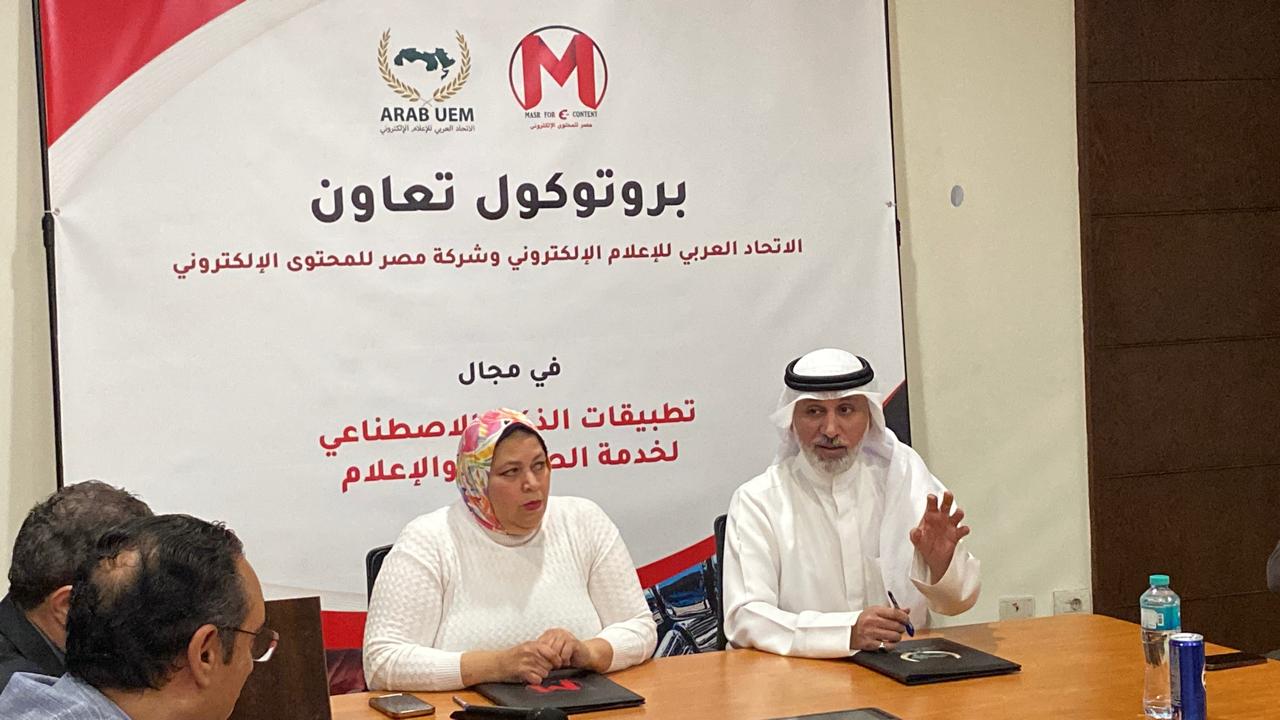
The visit featured several important meetings, most notably with media figure Osama Kamal, Chairman of the Board of Trade Fairs International, the organizer of the event, as well as with leaders of major technology companies. Discussions focused on avenues of direct collaboration to support media content with the latest technological and AI tools—talks that culminated in signing a major strategic cooperation protocol with “Egypt for E-Content.”
In a transformative step that marks a pivotal milestone in advancing the Arab media landscape, the Arab Union for Electronic Media and Sustainable Development announced the signing of a strategic cooperation protocol with “Egypt for E-Content,” a leading company specializing in using artificial intelligence applications for journalism. The protocol aims to transfer and localize the company’s advanced experience in deploying comprehensive AI systems in journalistic and media operations across media institutions in Kuwait and the wider Arab world under the umbrella of the Union.
This partnership stems from the strategic vision of H.E. Faisal Khalifa Al-Sougha to accelerate digital transformation and strengthen credible Arabic content. It also builds upon the pioneering role of “Egypt for E-Content,” which spearheaded the region’s first initiative to operate a full network of news portals entirely powered by artificial intelligence—earning it global partnerships and leading visibility on search engines.
The protocol establishes an integrated framework for transferring this expertise to media institutions affiliated with the Kuwaiti Union, and ultimately to members of the Arab Union for Electronic Media, supporting a complete shift toward AI-driven operations.
The partnership reinforces the Union’s strategic goals to develop digital media skills, enhance awareness of AI tools and ethics, and ensure the responsible use of these technologies in serving journalistic institutions and advancing trusted Arabic content.
The scope of cooperation encompasses wide and innovative fields, most notably the creation of AI-powered “smart newsrooms” capable of automated verification, review, and production of exclusive, authenticated content. It also includes collaboration in virtual media production, such as AI-generated anchors, correspondents, and entire virtual news teams, in addition to high-efficiency digital content
management and social media marketing.
As part of its commitment to supporting sector development, “Egypt for E-Content” pledged to fully develop and manage the official websites of the Arab Union for Electronic Media and Sustainable Development, the Kuwaiti Electronic Media Union, and the personal website of H.E. Faisal Al-Sougha—entirely free of charge, reaffirming its dedication to empowering the Arab media landscape.
H.E. Faisal Khalifa Al-Sougha, President of the Arab Union for Electronic Media and Sustainable Development, stated:
“Signing this protocol represents far more than a partnership—it is a declaration of our commitment to placing Arab media institutions at the forefront of global technological evolution.
We recognize that the future will not wait, and artificial intelligence is its drivingforce.
Our goal is to empower our members to build ‘the journalism of tomorrow,’ defined by unprecedented speed and precision. We also attach utmost importance to training our teams to use AI tools responsibly and ethically, ensuring that content credibility remains the highest value in the digital age.”
Aisha Al-Afifi, Editor-in-Chief of the tech news websites in Egypt and the Emirates and Chair of the Board of “Egypt for E-Content,” said:
“We are proud to serve as the strategic partner of the Arab Union for Electronic Media in this major leap forward. Our practical experience in operating the first fully AI-driven network of news websites in the region has proven that AI is not just a supportive tool—it is a complete engine for producing exclusive and innovative journalism.
We look forward to transferring this accumulated expertise, from building smart newsrooms to generating virtual correspondents, and to enhancing the capabilities of journalists in Kuwait and the Arab world.
This partnership sends a clear message: Arab media is ready to lead its digital future with intelligence and confidence.”
Dr. Waleed Hajjaj (The Hacker Hunter), Cybersecurity Expert and Advisor to “Egypt for E-Content,” added:
“The digital transformation underway in the media sector, as embodied in this strategic protocol, places enormous responsibility on us in the realm of information security. With AI becoming a core tool in editing and publishing, digital media becomes an increasingly attractive target for cyberattacks—not only to disrupt services but, more dangerously, to manipulate content and undermine credibility. This requires comprehensive fortification from infrastructure to AI algorithms
themselves.”
He emphasized: “Our work
focuses on building cyber-hardened newsrooms applying advanced encryption, multi-factor verification, and secure digital information supply chains—ensuring that AI-generated or AI-processed news is not injected with manipulated or misleading data.
Training media teams on proactive cybersecurity practices is essential to maintaining operational continuity and reinforcing public trust.
Media credibility is the first line of defense against cyberattacks aiming to spread chaos or misinformation.”
Dr. Neveen Hosny, Digital Psychology Consultant and Advisor to “Egypt for E-Content,” stated: “Amid the AI revolution reshaping media, digital psychology plays a decisive role in the success of journalistic institutions. AI can produce and edit content, but influence and engagement remain dependent on a deep understanding of Arab audience psychology.”
She added: “Our mission is to guide AI models to generate content that is not only accurate and well-sourced, but also emotionally resonant and culturally relevant. The shift toward full AI integration requires psychological readiness among journalists. Our training programs include modules on cognitive flexibility and digital-era innovation
psychology to ensure a smooth transition without affecting mental well-being or professional motivation.”
She emphasized the importance of analyzing behavioral data to optimize social media engagement strategies—timing, narrative patterns, visuals, and avoiding information fatigue—ultimately fostering a long-term trust relationship between media institutions and the public grounded in digital emotional intelligence.
Sherif Farahat, broadcaster, media consultant, and audio content advisor to “Egypt for E-Content,” stated: “Audio remains one of the most intimate and influential forms of media. In the digital era, AI-driven audio content, podcasts, and short-form videos offer unprecedented potential. This partnership marks a major step in integrating advanced voice-generation technologies and virtual broadcasters to craft a unique ‘audio identity’ for each news platform.”
He continued: “My role
focuses on ensuring top-tier media quality—training AI-generated voice models to sound natural and relatable, with correct tone and accent for Arab audiences. We also develop specialized workshops to empower journalists to create high-quality audio and visual content that elevates news coverage across platforms.”
He further noted: “Beyond voice generation, AI is used to identify the most engaging narrative patterns, select music cues, design transitions, and determine ideal clip durations for each platform.
This collaboration strengthens the position of Arab media in the global
audio-content landscape and expands its reach to audiences who increasingly prefer listening and watching over reading.”
68
previous post